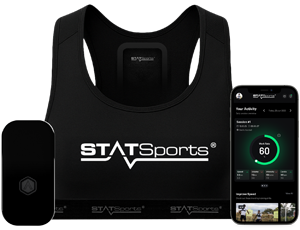


A physical development pathway is a long-term plan that connects a youth soccer player’s current capabilities with the demands of future playing levels. GPS data helps coaches establish individual baselines, identify development priorities and track progress across seasons.
For clubs, the process can follow a simple framework:
Baseline → Benchmark → Target → Train → Monitor → Reassess
Let’s use a hypothetical U14 female winger who wants to play NCAA Division I soccer.
Start With the Destination
Understanding the next level gives coaches context for planning development. Physical performance is one part of that picture, alongside technical ability, tactical understanding and other factors that influence progression.
The STATSports Benchmark Player Comparison tool allows coaches to explore relevant age-, gender- and position-specific comparisons, alongside higher-level playing profiles.
For our winger, college soccer provides a future reference point. It should help coaches ask:
- Where is she today?
- Which physical qualities need attention?
- What is an appropriate next step?
College benchmarks should inform a long-term plan, rather than become immediate targets for a 14-year-old.
Establish an Individual Baseline
Imagine our player’s established maximum speed is 15.3 mph. Before using that number, coaches need to understand how it was recorded.
A player’s highest match speed may not reflect how fast she can run. Tactics, position and available space influence whether she has an opportunity to reach maximum speed.
Dedicated sprint work early in training, after an appropriate warm-up and before fatigue builds, can help establish a more representative baseline. Allow enough space to accelerate and sufficient recovery between efforts, with the work suited to the player’s age, readiness and experience.
Use these efforts alongside training and match observations to reassess the baseline over time.
This helps distinguish between how fast the player can run and how fast a particular game allowed her to run.
Use Benchmarks to Build the Pathway
A baseline describes the player’s starting point. A benchmark provides context. An individual target is the next step selected by the coach.
Illustrative female winger development pathway

All figures above are for illustrative purposes only. They are not measured STATSports benchmarks or prescribed age-group targets. Actual benchmark data can be found in the STATSports Benchmark Player Comparison tool.
It does not establish the actual gap between youth and college soccer. Use verified comparisons to inform real decisions, alongside the player’s training history, growth, maturation and coaching observations.
The goal is to identify appropriate priorities and monitor individual progress.
Connect Training With Individual Monitoring

Players should not chase GPS numbers during matches. A winger facing a high defensive line may have repeated sprint opportunities; against a low block, those opportunities may be limited.
Consider the wider development environment:
Games + Team training + Targeted development = Total physical exposure
If matches provide limited opportunities to develop a particular quality, coaches can consider appropriate work elsewhere in the week. Account for recovery and activity outside the club, including school soccer and other teams.
An accurate maximum-speed baseline also supports individual monitoring. If a player’s maximum is 16 mph, then 90% is 14.4 mph. If her maximum increases to 17 mph, that threshold becomes 15.3 mph.
This calculation illustrates relative intensity; it does not prescribe how much sprinting a young player needs. Individual thresholds should also remain distinct from the standardized thresholds used for benchmark comparisons.
Ask two questions:
Long term: Is the player’s physical capability developing?
Week to week: Is she receiving appropriate opportunities to develop it?
GPS does not create the improvement. The training intervention does. The data helps coaches assess the response.
Maintain Continuity Across Seasons
A player may work with several coaches between U14 and U18. A shared record of baselines, development priorities, training interventions and reassessment findings helps each coach build on previous work.
GPS data collected over time can support that continuity when coaches record the context needed to interpret it.
No benchmark guarantees progression to NCAA Division I or international soccer. A consistent physical development pathway helps clubs connect future ambitions with informed coaching decisions today.
Don’t just track the player. Track their development.
Share article